San Geronimo Projects Provide New Habitat
From time to time, it’s important to pause in order to celebrate the victories we all achieve in the field of restoration and the roles we play improving habitat for other species. The San Geronimo Creek watershed is a major undammed tributary to the Lagunitas Creek watershed which supports coho salmon and steelhead trout, both listed species under the State and Federal Endangered Species Act (CESA/ESA). Lagunitas Creek has been identified as one of the most important waterways left for wild CA coho, and estimates of the annual coho population in the watershed, though greatly reduced, represent 10% to 20% of all wild California coho surviving today!
2024 marked the completion of two significant projects in the Landowner Assistance Program that Marin RCD implemented to enhance salmonid habitat in San Geronimo Valley (SGV). These projects are significant for a number of reasons, but to name a few:
- these are the first ever projects in SGV where significant large wood structures were installed in the creek for salmonid habitat on private properties;
- the projects required an inspiring amount of patience from landowners who waited nearly a decade for these projects to be implemented in their backyards;
- they were installed in an area of the watershed where instream wood habitat was scarce and now fish have been observed using the areas.
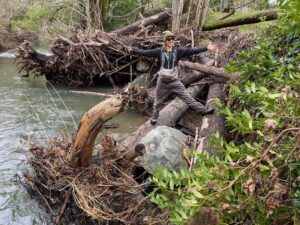
Instream wood features are vital, specifically for coho salmon (Oncorhynchus kisutch) providing immeasurable benefits as salmon co-evolved in rivers and creeks with fallen trees throughout. Specifically, large wood provides structure needed to shape the channel to create; complex habitat features, shade the stream for cooler temperature refuge, cover to escape predation, feeding opportunities on the aquatic organisms that decompose the wood, and velocity refuge during high-flow events. Large wood also sorts sediment for spawning gravels and creates scour pools which provide summer rearing habitat for juvenile salmon when areas of the stream channel begin to dry up in the hot summer months.
The Landowner Assistance Program was first started in 2010 by Marin County’s Department of Public Works, specifically Liz Lewis and Kallie Kull, with instrumental support from the late Jean Berensmeier at the SGV Planning Group. The goal of the Program was to engage and educate the community on salmonid habitat and how to work together with streamside landowners in SGV to create instream habitat on their properties. If you’re wondering why the San Geronimo Valley, well the San Geronimo Creek Salmon Enhancement Plan (SGVSEP) identified lower San Geronimo Creek as one of the reaches in greatest need of rehabilitation. These particular projects took place on private property and the homeowners remained dedicated to this project for over eight years.
In 2018, the implementation for the two projects was awarded by two different funding agencies: CA Department of Fish & Wildlife’s Fisheries Restoration Grant Program and the State Coastal Conservancy. The two projects were of high priority to receive funding because the habitat enhancement features constructed through these projects included wood structures that will decrease water velocities along the channel edge during winter flows and increase channel bed scour to create deeper pools that will provide summer rearing habitat with cover. During the winter, the slow channel edge water velocities adjacent to the structures provide refuge for salmonids so that they are not flushed out of the system.
Stillwater Sciences was the lead designer on the project and site construction was carried out by Glissman Excavating. Multiple years of monitoring is required per the permits issued at the two project sites. The monitoring included assessing geomorphic conditions, hydraulic responses to the project, counting the pieces of wood to ensure all were accounted for, counting the individual plants to determine plant survivorship, and assessing vegetative cover for potential erosion. Each metric had its own thresholds or goals to achieve, each year. It’s also important to note that project engineers conducted hydraulic modeling and wood stability analysis in advance to ensure the structures would not cause flooding in the Valley and were the appropriate size for the watershed itself and over-secured to ensure they stay in place.
The challenges were ever-present but all were overcome with persistence. Regulatory agencies were very supportive of the projects and offered guidance along the way. Many partners collaborated to pitch in on project costs. A special shout out to Charlotte Torgovitsky at Home Ground Habitat Nursery in Novato, who donated locally-grown native plants to each project site!
If you’re a streamside landowner in west Marin and observe fallen trees in the creek, consider leaving them upon review of this brochure from the County and RCD in Santa Cruz on Stream Wood. Urban Streams Program Manager, Sarah Phillips, is more than happy to come out to take a look at the fallen tree(s) to provide further guidance. Send a request to marinrcd@marinrcd.org.
To learn more about the value of instream wood for fisheries habitat, the creation of complex channels, and water quality improvement, check out UC Cooperative Extension’s, Maintaining Wood in Streams: A Vital Action for Fish Conservation.